
Career Guide: Geometry Teacher
Here’s what you need to know.
Toggle Navigation
Our Enrollment Counselors are here to answer your questions and walk you through the enrollment process.
Career Overview: Geometry Teacher
Have you noticed just how present geometry is in our everyday life? The angles that support a bridge, the dimensions of a room and the symmetry found in art all reflect principles that students encounter in geometry class.
The subject helps us understand shape, space and measurement while developing the reasoning skills needed to solve problems in mathematics and the world around us. A geometry teacher helps students make those connections.
By combining mathematical instruction with visual examples, technology and real-world applications, these teachers help students strengthen spatial thinking, logical reasoning and problem-solving skills. Geometry also provides an important foundation for advanced mathematics and many fields connected to STEM education.
For individuals who enjoy mathematics and helping others discover new ways of thinking, teaching geometry can offer a rewarding opportunity to influence how students understand the world around them.
What Is a Geometry Teacher?
So, what is a geometry teacher? These math educators specialize in teaching students about shapes, measurements, spatial relationships and the mathematical principles that connect them. Geometry education commonly includes concepts such as congruence, similarity, transformations, coordinates and proofs.
Beyond explaining geometry concepts, teachers develop math lessons, assess student progress and help students prepare for more advanced mathematics courses. They may work in public schools, private schools, charter schools or virtual learning programs. Geometry teachers typically need a strong mathematics background along with teacher certification or licensure that meets state requirements.
What Does a Geometry Teacher Do?
Teaching geometry involves helping students move beyond memorizing formulas to understand why mathematical relationships work. A geometry teacher combines instruction, visual learning and problem-solving activities to make abstract concepts more accessible while supporting students with different mathematical abilities.
Core Duties and Responsibilities
Common responsibilities include:
- Teaching geometry concepts and proofs while strengthening students’ mathematical reasoning
- Developing engaging lesson plans that align with curriculum standards and learning objectives
- Assessing student progress through assignments, projects, quizzes and exams
- Using technology and visual tools to help students explore shapes, transformations and spatial relationships
- Adapting instruction to support students with different learning needs and mathematics abilities
- Managing classroom activities while creating an environment that encourages participation
- Collaborating with teachers and families to support student progress and improve instruction
Work Environments
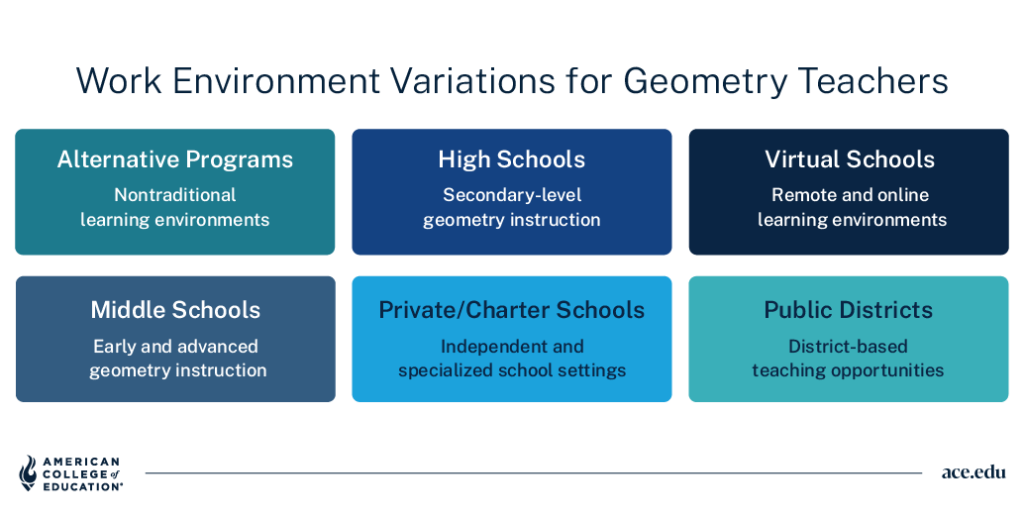
Geometry teachers most commonly work in high schools, although advanced mathematics courses may also be offered at the middle school level. Work environments include public school districts, private and charter schools, online programs and alternative education settings. The geometry curriculum and specific responsibilities may vary based on grade level, school structure and student needs.
Skills & Traits That Make a Successful Geometry Teacher
Successful geometry instruction requires mathematical expertise and the ability to make complex ideas understandable. Geometry teachers combine interpersonal strengths with technical teaching skills to create effective learning experiences.
Essential Soft Skills
Important soft skills in this profession include:
- Communication to explain abstract ideas in clear, approachable ways
- Patience and adaptability when students need concepts presented from a different perspective
- Leadership and classroom management to maintain an effective learning environment
- Critical thinking to guide students through logical reasoning and problem-solving
- Relationship-building to create trust and encourage students to participate
Important Technical Skills
Geometry teachers also benefit from:
- Strong knowledge of geometry and broader mathematics
- Geometry curriculum development and lesson planning
- Instructional design for different learning needs
- Educational technology and digital visualization tools
- Student assessment and data analysis
- Classroom management strategies
How These Skills Apply on the Job
A student who struggles to understand a geometric proof may benefit from seeing the problem represented visually or working through each relationship individually. Effective teachers adjust their approach to help students understand difficult material and develop confidence in mathematics. Strategies such as collaborative activities and math stations can also make mathematics more interactive and meaningful.
Teachers can also play an important role in helping students work through challenges such as math anxiety by creating supportive environments where mistakes become opportunities to learn.

Geometry Teacher Education Requirements
When exploring how to become a geometry teacher, requirements often include a combination of higher education, teacher preparation and state certification. Requirements vary by state and school setting.
Minimum Education Requirements
A bachelor’s degree is typically required to teach at the secondary level. Aspiring teachers may complete a degree in mathematics, mathematics education or another related field along with an approved teacher preparation program.
Student teaching provides supervised classroom experience before candidates pursue state certification or licensure. The United States Bureau of Labor Statistics (BLS) reports that public high school teachers must have a state-issued certification or license. Private and charter schools may not require certification.
Preferred Education Pathways
Some educators continue their studies through graduate programs in mathematics education, curriculum and instruction, or educational leadership. Specialized coursework in secondary mathematics can strengthen both subject knowledge and instructional expertise.
Certifications and Training Options
Certification requirements vary by state and may include examinations, teacher preparation and mathematics endorsements. Continuing professional development and graduate certificates can help experienced educators strengthen their skills or prepare for additional responsibilities.
How to Become a Geometry Teacher
The path to becoming a geometry teacher is largely dependent on your state’s requirements. However, the following steps can provide you with a general roadmap.
- Earn a Bachelor’s Degree
Start by completing a bachelor’s degree in mathematics, mathematics education or a related field. You’ll also need to fulfill applicable teacher preparation requirements for the state where you plan to teach.
- Complete Student Teaching
Gain supervised classroom experience through student teaching. This allows you to practice developing lessons, explaining mathematical concepts and managing a classroom with guidance from an experienced educator. If you already have a bachelor’s degree and are entering the profession through an alternative certification program, you may not need to complete student teaching, but requirements vary by state and may require different forms of supervised classroom or clinical experience.
- Earn Teacher Certification
Complete your state’s requirements for teacher certification or licensure, which may include passing required examinations and completing an approved preparation program. Requirements vary, so review the guidelines established by your state’s education agency.
- Apply for Geometry Teacher Positions
Once qualified, you can pursue secondary math teacher opportunities in middle schools, high schools and other educational settings. Depending on your certification and employer, you may teach geometry alongside other mathematics courses.
- Optional: Advance With a Graduate Degree
A master’s degree in mathematics education, curriculum and instruction, or educational leadership can deepen your expertise and help prepare you for opportunities such as department leadership, curriculum development or administration.
Day-in-the-Life & Real-World Scenarios
A Typical Workday
A geometry teacher may spend the day introducing new concepts, guiding students through proofs, and leading visual or hands-on activities. Outside instruction, teachers grade assignments, prepare upcoming lessons, and meet with students, families or fellow mathematics teachers.
Real-World Examples
Imagine asking students to determine the height of an object using angles and measurements rather than measuring it directly. Another lesson might use digital models to explore how rotating or reflecting a shape changes its position. These activities allow students to see geometric relationships in action while developing mathematical reasoning.
What Success Looks Like in the Role
Success can be seen when students begin explaining their reasoning, approaching unfamiliar problems with confidence and recognizing geometry outside the classroom. Effective geometry instruction prepares students for advanced coursework while strengthening skills that extend into STEM fields and everyday problem-solving.
Geometry Teacher Salary & Job Outlook
A geometry teacher's salary can vary depending on education, teaching experience, employer and geographic location. Educators often find opportunities in public school districts, private schools and other secondary education settings.
Schools continue to need mathematics teachers who can help students develop the reasoning and problem-solving skills required for advanced coursework and future careers. Educators who strengthen their subject expertise through professional development or graduate education may also prepare for opportunities in curriculum development, instructional leadership and school administration.


FAQs
What grades take geometry?
Geometry is commonly taught in high school, often during ninth or tenth grade, although course sequencing varies by school and student needs. Some middle schools also offer advanced geometry coursework.
What careers require geometry?
Geometry is useful in fields such as architecture, engineering, graphic design and cartography. Spatial reasoning and measurement are also valuable across many STEM careers.
Can a geometry teacher also teach algebra or other math courses?
Yes. Depending on certification, qualifications and school needs, a mathematics teacher may teach geometry alongside algebra or other secondary mathematics courses.
What skills are most important for teaching geometry effectively?
Strong mathematical knowledge, communication, patience and visual teaching skills are particularly valuable. Teachers also need classroom management and critical thinking skills to help students work through challenging geometry concepts.
How can geometry teachers keep students engaged in mathematics?
Teachers can connect geometry to real-world situations, incorporate visual models and use technology to help students explore mathematical relationships. Hands-on and collaborative activities can also give students new ways to engage with difficult concepts.
Help Students Find Their Passion for Geometry
Geometry gives students a new way to see the world, from the shapes surrounding them to the mathematical relationships behind structures, technology and design. A skilled geometry teacher can turn those observations into opportunities for students to reason, question and solve problems with greater confidence.
Whether you're preparing to enter the classroom or looking to deepen your expertise as a math teacher, ACE offers online education programs built for working teachers that can help you develop your knowledge and move toward your professional goals.